Is There a Google News API? What Developers Use Instead
No. Google shut down its Google News Search API in 2011, and nothing official has replaced it. Developers now use the Google News RSS feeds, SERP scraping APIs that return Google's result pages as JSON, or an independent news API such as GNews API, which returns top headlines based on Google News rankings and keyword search across 80,000+ sources.
Is there an official Google News API?
Google News is a product, not a developer platform: the only official API that touches news today is the Search Console API, which only reports on websites you own. Every result you find for "Google News API" is a third party.
What developers want from one is clear: the top headlines of a country or a category, keyword search with date filters, and structured JSON with title, source, date, URL, and text. Three families of tools provide that, with different trade-offs. They're compared below.
GNews API is one of them: an independent news API, not affiliated with Google, whose top headlines are based on Google News rankings by category, language, and country, and whose search covers 80,000+ sources with historical data since 2020.
Google News API alternatives compared
Three ways to get Google News-style data into your code. Each one is a reasonable choice: pick by what you need to build.
| Google News RSS | SERP scraping APIs | GNews API | |
|---|---|---|---|
| What it is | Google's own feeds for an edition, a section, or a search | Services that scrape Google News result pages and return them as JSON (SerpApi, Apify, SerpHouse) | An independent news API with its own index of 80,000+ sources |
| Official Google product | Yes, but not an API: no API key, no documentation, no support | No, built by scraping Google's pages | No, not affiliated with Google. Top headlines are based on Google News rankings. |
| Data per article | Title, link, date, source name | Title, link, date, source, thumbnail, position as ranked by Google | Title, description, full article content (paid plans), URL, image, publication date, language, and source |
| Top headlines by category and country | Yes, one feed per edition and section | Yes, as Google displays them | Yes: 9 categories, 41 languages, 71 countries, based on Google News rankings |
| Keyword search | Basic | Yes, within what Google displays | Yes, with search operators and filters for language, country, and date range |
| Historical data | Recent items only | Whatever Google's pages show | Since 2020 on paid plans, last 30 days on the Free plan |
| Stability | Format and limits can change without notice | Breaks when Google changes its layout, then fixed by the provider | A versioned, documented API (v4), with official SDKs for Python, JavaScript/TypeScript, and PHP, LangChain tools, and an MCP server |
| Price | Free | Pay per result, usually per 1,000 searches | The Free plan has 100 requests per day. Paid plans start at €49.99/month, with a 10-day free trial. |
| Best for | A personal project that needs a few headlines | Mirroring exactly what Google News shows on a page | Apps, feeds, monitoring, and AI agents that need structured articles and search |
Other news APIs such as News API, NewsAPI.ai, and The News API belong to the same family as GNews API: see how they compare.
Google News API in cURL, Python, JavaScript, PHP, and C#
There's no Google endpoint to call, so here's the request developers send instead. Sign up for free, verify your email address, copy the API key from your dashboard, and run one of these. No credit card needed, and no OAuth or SDK required.
curl --get "https://gnews.io/api/v4/top-headlines" \
  --data-urlencode "category=business" \
  --data-urlencode "lang=en" \
  --data-urlencode "apikey=YOUR_API_KEY"
These requests return the top business headlines of the moment, in English, based on Google News rankings. Change category for another section (general, world, nation, technology, entertainment, sports, science, or health), and add country or change lang for another edition.
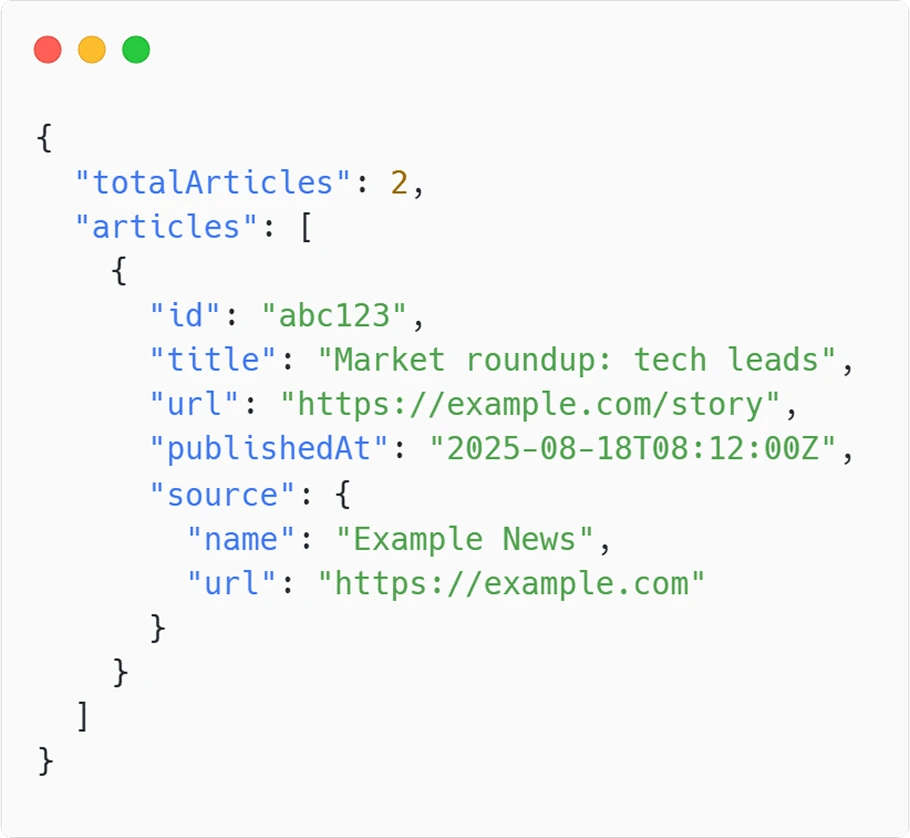
Every language gets the same JSON: the number of matching articles and the list of articles, where every article carries the same fields, from title and content to image, date, language, and source. JSON Response details each field.
Search by keyword
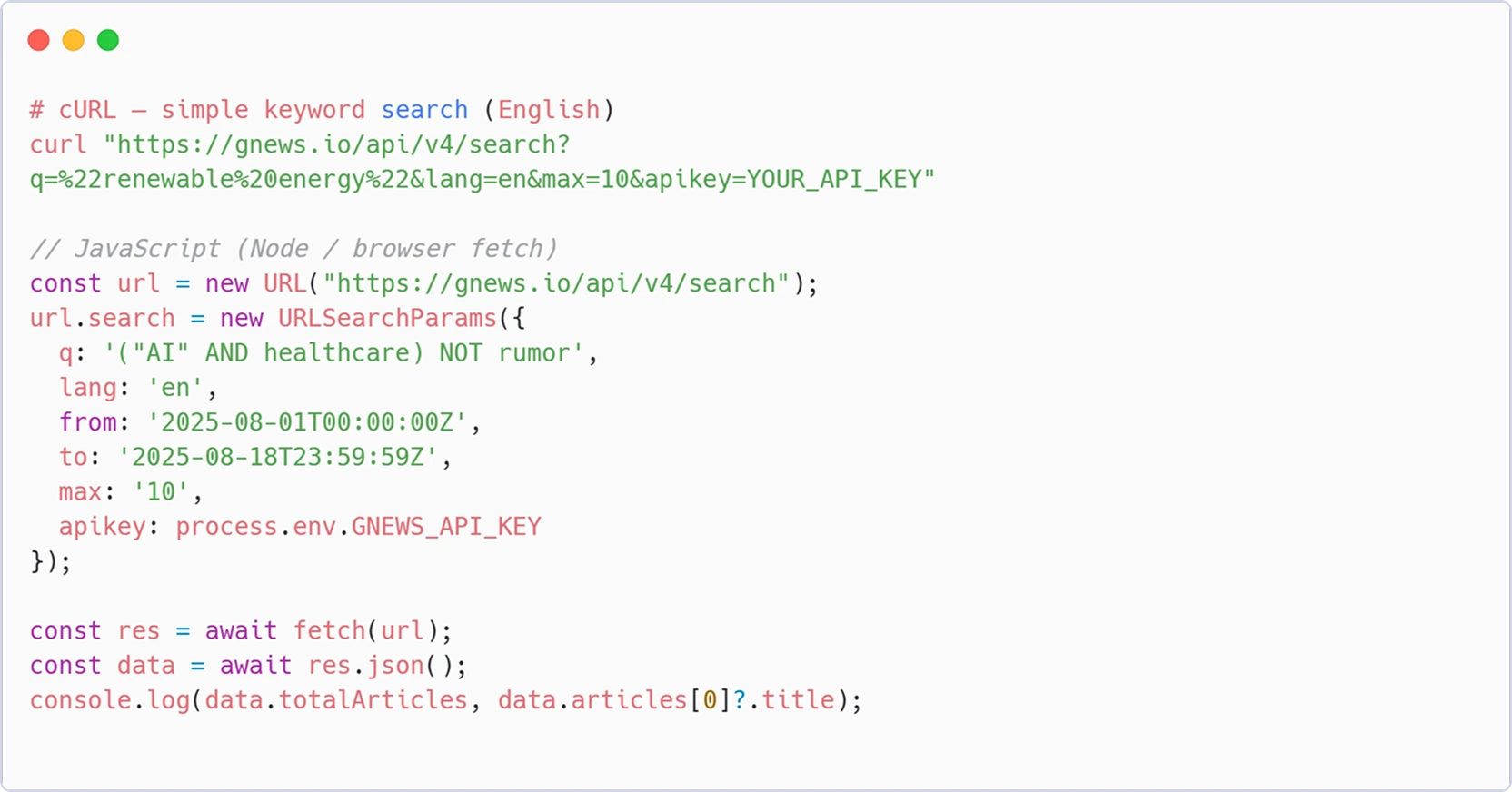
Swap the endpoint for search and pass your query in q. It's matched in article titles and descriptions (add in=title,description,content to search the article content too), with optional language, country, and date filters, and the most recent articles come first.
curl --get "https://gnews.io/api/v4/search" \
  --data-urlencode "q=AI" \
  --data-urlencode "lang=en" \
  --data-urlencode "apikey=YOUR_API_KEY"
Prefer a library?
Official SDKs wrap both endpoints and handle authentication, errors, retries, and response parsing: pip install gnews-io-python, npm install @gnews-io/gnews-io-js, or composer require gnews-io/gnews-io-php. For AI agents, pip install langchain-gnews adds top headlines and news search as LangChain tools, and the hosted MCP server connects Claude Code, Cursor, VS Code, or Gemini CLI without any code.
Is the Google News API free?
Google has no news API to price. The Google News RSS feeds are free but only carry a title, a link, a date, and a source name, and SERP scraping APIs charge per result. GNews API has a Free plan: 100 requests per day, up to 10 articles per request, a 12-hour delay, and the last 30 days of historical data, for personal, academic, evaluation, and other non-commercial projects. Paid plans start at €49.99/month for 1,000 requests per day, with real-time articles, historical data since 2020, and full article content. Every paid plan starts with a 10-day free trial.
Google News search API: keywords, dates, and languages
The closest thing to a Google News search API is the Search endpoint (/api/v4/search). It queries our index of 80,000+ sources rather than Google's pages, which is what makes date filters and operators possible:
q: the query, with exact phrases, parentheses, and the AND, OR, and NOT operators, for example"artificial intelligence" AND (companies OR technology)langandcountry: the language of the article and the country of its sourcefromandto: a publication date range, since 2020 on paid planssortby:publishedAtfor the most recent articles first, orrelevancemaxandpage: up to 100 articles per request depending on your plan, with pagination
See Query Syntax and Search Endpoint in the documentation. The API Playground in your dashboard builds the request for you.
What you can build
Add news features to your app or platform.
A few ways developers use it:
Current top headlines
Get ranked, real-time top headlines for news feeds, front pages, and dashboards, as JSON.
Advanced search
Search with exact phrases, parentheses, and the AND, OR, and NOT operators. Filter by language, country, and date range, for media monitoring, analytics, and RAG pipelines.

News feed for your website or app
Show a news module on your website or app, by category, language, or country, with article cards that stay up to date.

AI agents and datasets
Give an agent the day's headlines through the LangChain tools or the MCP server, or collect a recent, diverse dataset to train summarization, classification, or NER models.

Topic hubs
Build themed hubs, such as football transfers or film and TV releases, with filtered, frequently refreshed articles.
FAQ
totalArticles and an articles array where each article holds its text (title, description, content), its URL and image, its publication date and language, and its source. Most migrations swap the base URL, rename a few query parameters, and remap those fields. The documentation and the official SDKs cover the rest. /api/v4/search) finds articles by keyword, with search operators, language and country filters, a date range, sorting, and pagination. The Top Headlines endpoint (/api/v4/top-headlines) returns the current top headlines of a category: general, world, nation, business, technology, entertainment, sports, science, or health. Looking for something else? See all frequently asked questions.
Ready to build
with GNews API?
Get your API key and make your first request in minutes.